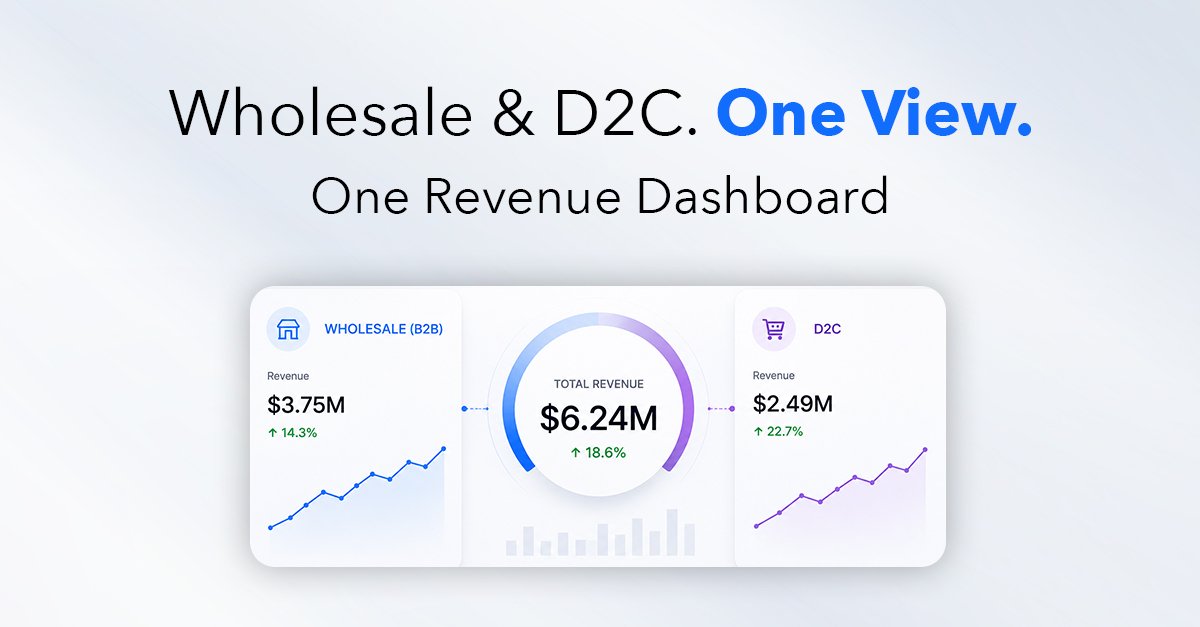
Today’s businesses rarely grow through a single channel. Most modern brands manage both wholesale operations and direct-to-consumer (D2C) sales at the same time. While wholesale teams focus on long-term B2B relationships and pipeline forecasting, D2C teams move quickly with online orders, campaigns, and customer engagement.
The problem? These two sides of the business often operate in completely different systems.
Leadership ends up looking at multiple spreadsheets, disconnected dashboards, and conflicting revenue reports. One team tracks pipeline value, another tracks digital sales performance, and nobody gets a clear picture of overall business growth.
That is where Msquare Automation helps. By combining B2B pipeline management, D2C analytics, and revenue reporting into one centralized dashboard, businesses gain a complete and accurate view of commercial performance, without the reporting chaos.
When wholesale sales data and D2C performance metrics live in separate platforms, decision-making becomes harder than it should be.
Sales leaders may see strong pipeline growth, while ecommerce teams report declining online conversions. Finance teams spend hours manually combining numbers. Leadership meetings become discussions about “which report is correct” instead of focusing on growth opportunities.
Over time, disconnected reporting creates operational friction that limits visibility, efficiency, and scalability.
The solution is not more reports. It is smarter visibility.
By integrating B2B pipeline tracking, digital commerce analytics, and real-time revenue data into one connected system, businesses can finally understand how every sales channel contributes to growth.
With Msquare Automation, every department works from the same commercial data, creating faster decisions, cleaner reporting, and stronger alignment across the business.
When wholesale and D2C data come together, leadership no longer has to guess what is happening across the business.
Instead of chasing reports, teams can focus on improving performance and driving revenue growth.
The line between wholesale and direct-to-consumer sales is becoming increasingly blurred. Many businesses now operate hybrid models where products are sold through distributors, retail partners, ecommerce platforms, and direct customer channels simultaneously.
But while revenue flows through multiple channels, leadership still needs one clear answer to a simple question:
How is the business really performing?
Without connected reporting, businesses only see fragments of the bigger picture.
A unified commercial dashboard helps organizations combine sales performance, pipeline visibility, and customer insights into one real-time operational view.
Unlike e-commerce sales, wholesale revenue does not happen overnight. B2B deals often move through long sales cycles involving negotiations, approvals, forecasting, and account management.
That makes pipeline visibility incredibly important.
When businesses rely on outdated spreadsheets or disconnected CRM systems, it becomes difficult to understand:
With centralized reporting, leadership can track wholesale performance more confidently and make smarter forecasting decisions based on real-time pipeline activity.
Direct-to-consumer operations create a different type of challenge. Online sales generate high volumes of customer and transaction data every day.
Businesses need immediate visibility into:
The issue is that many D2C dashboards operate independently from wholesale reporting systems.
As a result, leadership sees ecommerce performance separately from overall business revenue, making it harder to understand the complete commercial picture.
One of the biggest advantages of unified reporting is clarity.
Instead of pulling reports from multiple teams and platforms, businesses can access one centralized dashboard that reflects real-time commercial performance across every sales channel.
This creates:
When every team works from the same numbers, decisions become faster, easier, and more reliable.
Manually combining B2B and D2C reporting takes time, creates inconsistencies, and increases the risk of errors.
Msquare Automation helps businesses automate data synchronization across wholesale systems, e-commerce platforms, CRMs, and reporting tools, so leadership always has access to accurate and updated performance insights.
The result is a more connected business that spends less time organizing data and more time acting on it.
Today’s businesses operate in fast-changing markets where customer behavior, sales trends, and revenue performance can shift quickly.
Leadership teams need real-time visibility to make confident decisions.
Businesses that continue operating with disconnected reporting systems risk:
Businesses that unify wholesale analytics and D2C sales intelligence gain a major competitive advantage through faster insights, better forecasting, and stronger commercial control.
Wholesale and D2C channels may work differently, but they should never be measured separately.
When businesses combine B2B pipeline visibility, D2C sales analytics, and revenue intelligence into one centralized dashboard, leadership gains the clarity needed to scale confidently.
With Msquare Automation, businesses can eliminate disconnected reporting, improve forecasting accuracy, and create a true single source of revenue truth across every sales channel.
Because better visibility leads to better decisions, and better decisions drive growth.
Ready to bring your wholesale pipeline and D2C sales performance into one powerful commercial dashboard?
Build a smarter, faster, and more connected revenue operation with MsquareAutomation today.

 Contact