If your business moves goods across borders, you already know the paperwork never stops. Bills of lading. Certificates of origin. Customs declarations. Compliance certificates. Packing lists. Every shipment generates a stack of documents, and every document contains critical data that your finance, logistics, and compliance teams urgently need.
The problem is that most businesses are still processing these documents the old way, manually. Someone downloads a PDF, reads through dense tables and fine print, re-enters numbers into a spreadsheet, and emails it to three different departments. Then someone else catches a typo. Then a customs deadline gets missed.
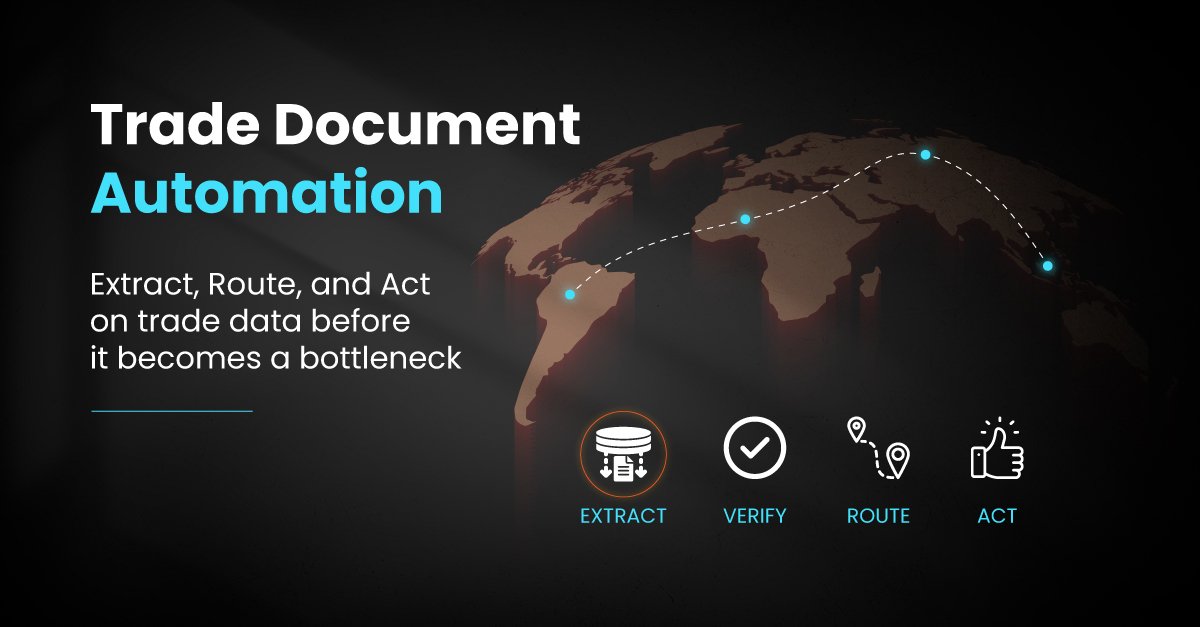
That is where Msquare Automation changes everything. By combining OCR technology and AI-powered data extraction, businesses can automatically pull structured information from trade documents and route it directly to the right teams, without human handling, without delays, and without errors.
Trade documents are not simple. A single bill of lading can contain dozens of data fields. A customs declaration needs precise values, HS codes, and origin details. A certificate of origin must match corresponding shipment records exactly.
When this work is done manually, errors are almost inevitable.And the consequences of those errors? Shipment holds. Compliance penalties. Delayed payments. Strained supplier relationships. Regulatory risk.
What Happens When Trade Document Processing Stays Manual
The real cost is not just time. It is the risk that builds quietly every time a document is processed by hand.
The answer is not hiring more document processors. It is building a smarter document workflow. With AI-powered OCR and intelligent data extraction, businesses can automatically identify, read, and structure the information inside trade documents, regardless of format, layout, or origin.
What Trade Document Automation Can Handle
Once extracted, the data is validated, structured, and automatically routed to finance systems, compliance platforms, ERP tools, or team inboxes, whichever workflow your business needs.
When intelligent automation handles the heavy lifting of document processing, every team that touches trade operations becomes faster, more accurate, and less reactive.
Key Benefits Of Automated Trade Document Processing
Less time chasing paperwork. More time managing the business that depends on it.
A bill of lading looks like a straightforward shipping record. But inside that document are dozens of fields that touch multiple departments simultaneously. Finance needs the invoice value and payment terms. Logistics needs the vessel name, port of discharge, and estimated arrival. Compliance needs the HS codes, country of origin, and any applicable trade agreement references.
When that document arrives as a scanned PDF or an emailed attachment, someone has to manually pull all of that apart and send the right pieces to the right people. In high-volume operations, that someone is doing it dozens of times a day.
OCR and AI extraction eliminate that process. The document comes in, the system reads it, and the data goes where it needs to go, automatically.
Customs declarations are legally binding documents. The values, classifications, and origin details they contain determine duties owed, clearance timelines, and regulatory compliance.
Even a small error, a misclassified HS code, an incorrectly declared value, or a missing certificate reference can trigger a shipment hold, an audit, or a financial penalty. Automated extraction does not get tired. It does not misread a field because it is the hundredth document of the day. It applies the same validation logic to every document, every time, flagging anomalies before they become problems.
For businesses moving goods across multiple trade corridors, that consistency is not just convenient, it is essential.
One of the most overlooked costs of manual trade document processing is what it does to finance team productivity.
When accounts payable, treasury, or trade finance teams have to wait for document data to be manually extracted and forwarded, payment cycles slow down. Cash flow visibility suffers. Reconciliation becomes a guessing game.
With automated document routing, finance teams receive structured, verified data the moment a document is processed. Invoice values, shipment references, and payment terms arrive in the right system, in the right format, without anyone acting as a data courier between a PDF and a spreadsheet.
For businesses operating under preferential trade agreements, certificates of origin are not just administrative paperwork. They are the documentation that determines duty rates and trade agreement eligibility.
Verifying these documents manually, cross-referencing product codes, checking issuing authorities, and confirming eligibility criteria is time-consuming and prone to inconsistency.
AI-powered extraction captures every relevant field accurately and can be configured to flag documents that fall outside expected parameters, giving compliance teams a faster, more reliable review process.
Most businesses manage trade document volume reasonably well during steady periods. The system breaks during peak shipping seasons, new market launches, or supplier onboarding surges.Suddenly, the team is processing twice the volume with the same headcount. Errors increase. Response times slow. Compliance deadlines get close.
Automation scales with volume. Whether your business processes fifty documents a week or five thousand, the extraction logic runs the same way. No backlogs. No bottlenecks. No rushed data entry.
The real competitive advantage of trade document automation is not just speed, it is the quality of decisions that speed enables. When finance has real-time shipment values, compliance has instant access to verified declarations, and logistics teams can act on accurate arrival data, the entire business operates with better information. That means faster customs clearance. Stronger cash flow management. Cleaner compliance records. Smarter supplier negotiations.
Msquare Automation connects the document-heavy world of trade operations to the real-time visibility modern businesses need to grow without friction.
Trade documents will always be part of cross-border commerce. But manually processing them does not have to be. When businesses apply intelligent OCR, AI-powered data extraction, and automated document routing to their trade operations, they eliminate one of the most persistent and costly sources of manual work in finance and compliance.
With Msquare Automation, every bill of lading, customs declaration, certificate of origin, and compliance form becomes a source of clean, structured, instantly available data, ready for the teams that need it, the moment it arrives. Because in trade, accuracy and speed are not just operational goals. They are the difference between shipments that clear and shipments that don’t.
Stop losing time and taking on compliance risk with manual document processing.
Let Msquare Automation extract, validate, and route your trade data automatically, accurately, and at any scale.
Opens a print-ready version — use your browser's Save as PDF option.
Download PDF
 Contact